
Still a missionary

I am working in the emergency shelter at the mission in Holland, and still have contacts with friends and family in Africa. One day I realized that there are lots of things I would have shared with people for their advice and prayers as an overseas missionary that I have not been sharing here in the US. Here's an attempt to change that.

My Photo
Name:
Location: Zeeland, Michigan, United States

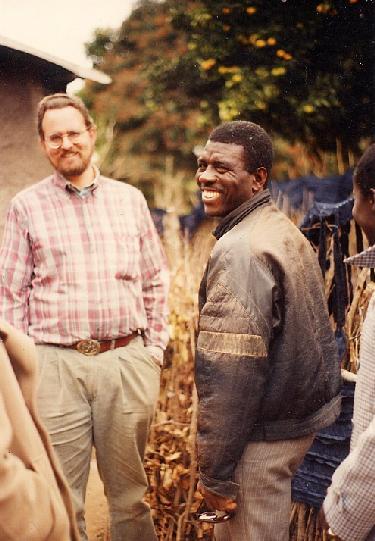
Yes. I know this picture's 10 years old.

Tuesday, August 29, 2006

We were just sitting there talking


I recently finished Dorothy Day's book The Long Loneliness. I once heard a Catholic priest at the Keur Moussa monastery in Thies, Senegal, give a homily on the love of God. God's love, he said, is like the water in Manon of the Spring. You know the source from the dirt in the water, even when you can't tell how it got to where you're seeing it now.


Here is Dorothy Day:

POSTSCRIPT
WE WERE just sitting there talking when Peter Maurin came in.

We were just sitting there talking when lines of people began to form, saying, "We need bread." We could not say, "Go, be thou filled." If there were six small loaves and a few fishes, we had to divide them. There was always bread.

We were just sitting there talking and people moved in on us. Let those who can take it, take it. Some moved out and that made room for more. And somehow the walls expanded.

We were just sitting there talking and someone said, "Let's all go live on a farm."

It was as casual as all that, I often think. It just came about. It just happened.

I found myself, a barren woman, the joyful mother of children. It is not easy always to be joyful, to keep in mind the duty of delight.

The most significant thing about The Catholic Worker is poverty, some say.

The most significant thing is community, others say. We are not alone any more.

But the final word is love. At times it has been, in the words of Father Zossima, a harsh and dreadful thing, and our very faith in love has been tried through fire.

We cannot love God unless we love each other, and to love we must know each other. We know Him in the breaking of bread, and we know each other in the breaking of bread, and we are not alone any more. Heaven is a banquet and life is a banquet, too, even with a crust, where there is companionship.

We have all known the long loneliness and we have learned; that the only solution is love and that love comes with community.

It all happened while we sat there talking, and it is still going on.

Wednesday, August 23, 2006

Finding an answer to child soldiers


When I was at Calvin College and hung around some with some philosophy majors, we used to joke about what they'd do when they'd get out of college. "Open a philosophy shop" was a common suggestion.

Keeping up with events in the Democratic Republic of the Congo, where I served in Peace Corps from 1982-86, has led me to one life after college for a philosophy major that none of us had ever considered: Edward Rackley works as a consultant to international agencies operating in conflict and post-conflict contexts, primarily in Africa. In a posting on his blog entitled No shame for the shameless, he says, "As most of you know, I've been working with child soldiers in the DR Congo most of this year."

Edward Rackley's blog is called Across the divide: analysis & anecdote from Africa and he has another article about the eastern Congo called Lawlessness and Lucre in Eastern Congo.

Finding an answer to child soldiers and what creates them is certainly one of the great spiritual challenges of our time. C.S. Lewis wrote somewhere of "the great men who built up the Middle Ages", and one of the things they did was to limit war and who took part in it. We need to create our own limits, but this time we need to do it so that it applies for wars with other races and ethnic groups as well, something Europe in the Middle Ages never got to.

Rackley mentions reading P.W. Singers' Children at War. I checked and it's available in our local libraries here in West Michigan. It on my to-read list.

Wednesday, August 16, 2006

Vocation


The following entry in Buechner's book is one I have always lived by and found most useful, and one of the reasons I always keep a copy of the book around.

VOCATION
It comes from the Latin vocare, to call, and means the work a man is called to by God.

There are all different kinds of voices calling you to all different kinds of work, and the problem is to find out which is the voice of God rather than of Society, say, or the Superego, or Self-Interest.

By and large a good rule for finding out is this. The kind of work God usually calls you to is the kind of work (a) that you need most to do and (b) that the world most needs to have done. If you really get a kick out of your work, you've presumably met requirement (a), but if your work is writing TV deodorant commercials, the chances are you've missed requirement (b). On the other hand, if your work is being a doctor in a leper colony, you have probably met requirement (b), but if most of the time you're bored and depressed by it, the chances are you have not only bypassed (a) but probably aren't helping your patients much either.

Neither the hair shirt nor the soft berth will do. The place God calls you to is the place where your deep gladness and the world's deep hunger meet.

Saturday, February 11, 2006

Peterson: "Eat This Book"

I am listening to Eugene Peterson's lecture in the Calvin January Series as I write this, for the 2nd time tonight. http://www.calvin.edu/january/2006/peterson.htm

By the way, I did have change several things in the Realplayer Preferences on the Tools menu. Specifically, I changed the number in "More options" under Playback Settings to "Buffer up to 300 seconds of the clip before playing if needed", in addition to changing the Connection and Server settings to 300 seconds under Connection.

Peterson's lecture reminds me of the Bible entry in Frederick Buechner's Wishful Thinking: A Seeker's ABC (or A Theological ABC, as the subtitle in the original edition put it. The book is still in print: see http://www.amazon.com/gp/product/0060611391/sr=8-1/qid=1139715409/ref=pd_bbs_1/104-8593109-6450365?%5Fencoding=UTF8.

It was from Beuchner that I first heard of Karl Barth's dusty windows. That struck me as TRUE, and I suppose that looking through the windows and getting out into the street is what I have been trying to do ever since (and maybe before, of course). This vision of things is one reason that I do not much worry about which translation I use, though I still tend to favor a more word-for-word translation. Any translation is good enough to see through, though, and of course what we're really supposed to do is to move out into the real world outside: the Christian claim is not that "religion is good" but rather, first of all, that each of us can know the God who spoke to Moses from the burning bush, and also that we truly will if we will but seek Him.

Thursday, January 26, 2006

The prayer of Jabez

I heard recently that Bruce (The Prayer of Jabez) Wilkinson's effort to make a difference in Africa has foundered and he has bailed out (http://www.christianitytoday.com/ct/2006/002/8.76.html).
 
I never could bring myself to read The Prayer of Jabez. The specter of millions of rich, fat, contented American Christians praying, "Lord, enlarge my tent" has always repulsed me. OF COURSE they'll enlarge their tent. They're too fat to fit in their old one.
 
Maybe Wilkinson got it right in the book. As I said, I haven't read it. My reaction is to how American Christians reacted to it. That was definitely the rich wanting more and more. There may be a fifth thing that never says enough, that being Christians rich in the things of this world.
 
Jabez is about crying out in your pain to the Lord and what God does about that. Do that. Find where it leads.

Wednesday, October 12, 2005

Caring for our own

We want other people to know our joys and our suffering, yet we fear people who would use what they know about us to hurt us.

Alcoholics Anonymous has built a powerful organization around people sharing their deepest hurts and joys with each other while at least pretending not to know more than the other people's first names. I think, though, that we long for more than that, even if we will settle for one of the "Anonymous" groups, should that be all we can find.

Church people pray for each other. But all of us know that sharing prayer concerns can very easily become "Did you hear about so-and-so?" I'm not always sure that I want church people praying for me.

I trust family more. Family know we're still family and will live or hang together, even when we don't think alike or even like each other all that much, even when we don't spend that much time together. Some people's experience of family, though, is very different from mine. And if I'm honest, I must admit that many of the people I treat as family are not blood relatives of any kind.

The people I trust are the people who have shown that the union between us doesn't go away even when we disagree strongly or when we don't see things the same. We do seek the best for each other, even when we don't agree very much about the means to that end.

The prayers of such people can make all the difference in the world. A woman at work told me of how she was going through a period in her life when she just couldn't make any sense of the suffering she had to endure. She told a friend about this. Over the next few months, she came to understand better and better what God was doing in her life. This amazed her, because she hadn't been able to see any of this before. One day she told her friend of what she had been experiencing and of her amazement at what she could see now, of how she couldn't understand why she hadn't been able to see it before. Her friend told her that she had been praying about this for her ever since she had spoken with her.

Sometimes, though, people will hurt us, intentionally or not. We must train ourselves to seek our identity in God alone and not in what others think or say. When others hurt me, I must make myself take what they say or think to God, for His appraisal. Unless He confirms it, it means absolutely nothing. It will be soon gone without a memory. If I fail to go to God, I will suffer, but I should recognize before long that my hurt is of my own making. I did not seek God's appraisal.

There is a mystery--and a joy--in all this and we are not often getting it right these days.

Home is where one starts from. As we grow older
the world becomes stranger, the pattern more complicated
Of dead and living. Not the intense moment
Isolated, with no before and after,
But a lifetime burning in every moment
And not the lifetime of one man only
But of old stones that cannot be deciphered.
There is a time for the evening under starlight,
A time for the evening under lamplight
(The evening with the photograph album).
Love is most nearly itself
When here and now cease to matter.
Old men ought to be explorers
Here or there does not matter
We must be still and still moving
Into another intensity
For a further union, a deeper communion
Through the dark cold and the empty desolation,
The wave cry, the wind cry, the vast waters
Of the petrel and the porpoise. In my end is my beginning.
(T.S. Eliot, East Coker)

Monday, October 03, 2005

It makes a difference for that one.

I just received what I take as a high compliment. One of the men who has been around the mission for a long time now and works some in the emergency shelter told me I had to read the meditation for Monday, October 3, from the TODAY daily devotional.
 
The meditation contained the story about the boy throwing starfish back into the sea.
"What are you doing? the man asked as he walked up to the boy. "I'm saving the starfish," the boy said. The man looked along the shore and replied, "Don't you realize there are miles and miles of beach, and starfish along every mile? You can't possibly make a difference!" The boy picked up another starfish and flung it into the ocean. "It makes a difference for that one," he said.
I read it just before heading for home tonight. I told him I knew that story, and I asked him why he wanted me to read the meditation. "When I read it," he said, "I thought of you."