
Still a missionary

I am working in the emergency shelter at the mission in Holland, and still have contacts with friends and family in Africa. One day I realized that there are lots of things I would have shared with people for their advice and prayers as an overseas missionary that I have not been sharing here in the US. Here's an attempt to change that.

My Photo
Name:
Location: Zeeland, Michigan, United States

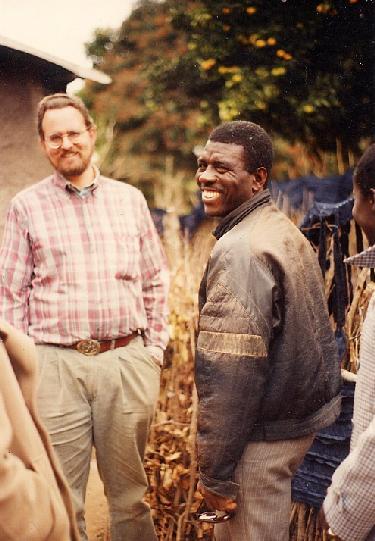
Yes. I know this picture's 10 years old.

Tuesday, August 30, 2005

Left Behind--in a broken family

On Monday Bob Herbert had a piece in the New York Times entitled "Left Behind, Way Behind" where he speaks of how poorly American children are doing in school and of a Program for International Assessment report that proposes to address this with changes to how schools operate.
 
I don't understand how he can write an article like "Left Behind, Way Behind" without any reference to all the broken families that those children he speaks of belong to. I am married to a woman from Africa, and with just the educational differences of two educational systems and two languages, we find it challenging to keep our children up to speed in school. But there are two of us. I do not see how grandma or mom by herself can possibly carry the load, even though I know some of them do. I have great respect for anyone with that capacity, and most of those are women. I also know that a lot of them do not and cannot. I hurt for them.
 
Since we returned to the US in 1999, I have been trying to come to grips with how American society and even just my hometown have changed in the years I was away. One of the biggest changes I see is in The terrible cost of broken families. In Africa I had gotten used to a whole extended family raising children. Africans never believed that raising children was something for just mother and father, but it always includes the whole extended family. Your grandparents, and your cousins, have a lot to do with how you grow up. Given the terrible difficulties of finding a job in much of Africa, your father might well be absent. But he is your father, he and your mother are usually still married, and he has lots of help in raising you. Given all the help built into the society, even when there is a divorce, there is usually remarriage on both counts and all those grandparents, aunts and uncles, and cousins help ease the pressure on any one individual.
 
I realize after reading this Bob Herbert article that when I wrote The terrible cost of broken families earlier this month, I was mostly writing about white kids. That's largely because of the area I live and work in. If I can pick up anything from all the African-Americans men I know, most all of them over 30, I'd say that their kids are just as scarred but live with a lot more violence and drugs that the young white kids I see firsthand. They're a generation ahead of where the white kids are--the men I know lived through this themselves. I think their kids are trying to rebuild that extended family with kids their own age--call it a gang if you want. As individuals, they are overwhelmed by the situation, even when they care for their kids deeply and long to see them do well--and I am talking about the African-American MEN. I think we need to work together to create an expectation, a way of being, in our families of a inescapable responsibility to raise our children as an EXTENDED FAMILY. Where the immediate family isn't there, then the religious community steps in, but it must be multi-generational and as many people as possible.
 
I do not believe that any school system can ever hope to do what Bob Herbert and this report calls for without this true family being there for these kids to belong to.

Wednesday, August 10, 2005

AIDS test

My sister-in-law who had the positive test for AIDS in a screening test in Labé has gone down to Conakry to go to the John Paul II hospital in the the capital city to have a more definitive test done. She went once before to Conakry, and the test was negative in Conakry, but she suspects that she was just told the test was negative because there wasn't much she could do anyway. Now she is hoping that she will find someone she can trust to tell her the truth, whether it is good or bad news.

Sunday, August 07, 2005

Taizé Worship

I enjoy worshiping with the songs and silence of Taizé as much as any other way I know to worship.

Sing with all your heart to the Lord!

I am still worshiping at home with the kids, since last fall when Salimatou decided she was not going to let the kids go to church with me any more unless I sent them to mosque with her. Salimatou and I still live with our severe differences, and worshiping only at home has its problems, but I should have been leading them in worship at home before all this happened.

We have had some very good worship times. Abraham and Maria sing more than they ever did at our church in town. Partly that is because we have chosen songs they know and also sing songs more often than would happen with the greater variety of songs at the church in town. We have had good times of prayer, and each of us has also had a time when we really heard what the Bible says. Worship at the church in town just isn’t geared for a 7-year-old and a 9-year old.

We often use songs from Taizé. I love the Taizé songs, and I have found to my delight that Abraham and Maria like them more than I expected they would and have been participating more and more.

About two weeks ago now I also led a Taizé worship during the evening chapel time at the mission. I wondered if I was going to be singing by myself.

There was a time a couple of summers ago when I led many Taizé worships at the mission. There was a time when we were between chaplains at the mission when no one would show up for the chapel service for several nights each month, and many of the nights I led a Taizé worship. Once several of the men learned the songs, the participation was very good.

Now it had been a long time since I had led a Taizé worship at the mission, several months at least. This time, however, several men made an effort to sing along even though they didn’t know the songs. The good thing about the songs from Taizé is that, since the songs are short and you sing them over and over, you can pretty much learn a song even the first time you sing it.

At the mission I sing 2 to 3 songs and then have a Bible reading followed by 5 to 15 minutes of silence. I break the time of silence with an Alleluia response and then have sentence prayers for 5 minutes or more, following each prayer with the Alleluia response. The Alleluia response sung to God helps keep the prayers more focused on God and his power. After the prayer time, we sing 2 to 3 more songs to conclude the worship time.

A man who serves as resident assistant kept the phone and was in the back of the chapel for much of the service. After we finished our worship time, he asked me if I noticed that of all the men besides me who prayed, all but one were minorities.

I hadn’t noticed. I sit in the front row and face the front. (I also always remove the lectern to remove anything between the men and God.) I recognize some of the voices, but never all of them. However, I have noticed that minorities (mostly African-Americans and Hispanics) participate much more than the whites. For the Hispanics, perhaps you could say that it reminds them of some of the singing in Catholic churches. For the African-Americans, I think they’re already used to dealing with strange cultures and have things different from what they know forced on them all the time.

I hand out two sheets at the beginning, one page with the words to the songs in the order we’re going to sing them, and another sheet with at least the Bible text of the passage we read. After the worship time, I tell everyone they may take the sheets if they want but to leave them on the chairs if they don’t and we’ll pick them up. Very often either a man who liked the service a lot or, even more often, one of quieter or more unpopular of the men will make it his job to help me pick up the papers. Even the outsiders find a place where they belong.

Saturday, August 06, 2005

The terrible cost of broken families

There are a lot of kids paying a terrible price for all the broken families in America. Just among my kids' friends I know several who bounce back and forth between two parents. At the emergency shelter where I work we see some of the worst casualties of how many divorces we have today in America.

Africans raise kids as a whole community or at the least an extended family all helping out. And there are just a lot more kids around, and the older ones learn early to look out for the younger ones. America with its mom & dad and kids alone against the world can’t handle its family breakdowns as well as African communities can.

I don't know how many young men I've gotten to know in the time I worked at the mission who ended up homeless because mom might have accepted them but stepdad wouldn't have them. Other times it's mom who wants a better life and teenage boys, especially if they have any issues, don't fit into the picture. Many time these young men aren't very nice. Some of them are absolute jerks all the time and most all of them are jerks some of the time. Lots of times they're lazy and hope to find the easy life at the mission that they couldn't find at home. I wonder, though, how I'd have turned out if I had lived through even part of what so many of these guys have had to endure. Give glory to God if you had parents you could respect for how they lived and how they treated you.

I don't see the girls much. I wonder if it's easier for a boy to turn into an absolute jerk that mom and stepdad put out. Of course, I work in the men's shelter and wouldn't have much contact with such girls anyway. I know there's girls with real tragic stories, too.

I pray for these kids and these families. At the mission I try to call the guys I meet there to seek God and to live right even if people aren't doing right by them. I call them to a high standard as best I can. I have some who hate me for trying this or even suggesting it.

I wonder about what church outreach programs there are for these kids. There are some church programs for young people today call Christian young people to righteousness. It seems to me, though, that in what programs there are for young people outside the church, we're usually trying to reach out to young men like those I deal with at the mission with programs focusing on acceptance and not righteousness. We try to attract them with music like theirs and an accept-anything attitude and then hope they realize there's more to Christianity once they're "inside the church". I suspect that their mom and stepdad often tried the acceptance route as well and that's part of what turned so many of them into people who expect to always get their way.

Friday, August 05, 2005

Steeles were on that plane.

Sent: Thursday, August 04, 2005 5:48 AM
Subject: Steeles

Greetings all,

Got a prayer request for you.  You probably heard about the Air France plane crash in Toronto.  Steeles were on that plane.  They are pretty much okay but are shook up and lost everything except the clothes on their backs.  Thank God with us for sparing their lives and pray for them as they work through the trauma of it all.  Bill's comment was that God must still have a purpose for their lives.  Amen!!

Looking forward to seeing you all soon.

Thanks,
Brenda


Thursday, August 04, 2005

Typhoid? Aids?

Yesterday morning I was able to talk at length by phone with one of my sisters-in-law in Labe. She says she has been sick since January this year. She went to the doctor in Labe (where she also works), and he diagnosed her with typhoid fever and malaria. He also gave her a HIV test and that came back positive. He sent her to Conakry for a second test and that test was negative. However, she believes that the Conakry hospitals just produce negative tests because if they believe you have AIDS they write you off as dead.

She says that her whole body hurts and she is always very tired. She says she has no diarrhea or vomiting but she has lost a lot of weight. She can't eat any milk products like yoghurt or leaf sauces.

The doctor told her to take amoxycillin and paracetamol and two other drugs that I don't know how to spell the name for but that she gave us as Prosinide and Cinatine. The doctor also told her to eat well and avoid any really hard work. She has not been taking the medication for at least two months because she doesn't have the money. She does not know that her husband had any positive HIV test before he died in Dakar in 1999. She does say that he was not kept in the usual wardfor TB patients and she wonders about that. She wants AIDS meds NOW because she's sick and tired of being sick.